
SoftBank’s Bold Comeback in Robotics
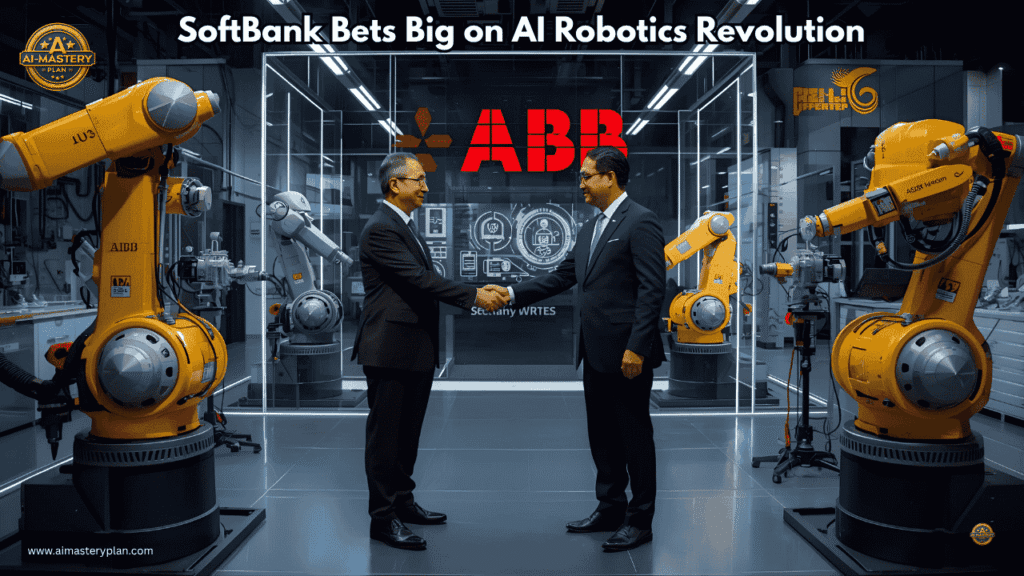
SoftBank founder Masayoshi Son has made a dramatic return to the world of robotics. The Japanese tech giant announced a $5.4 billion deal to acquire ABB’s robotics division, marking one of its biggest moves in recent years.
This acquisition signals SoftBank’s renewed ambition to merge artificial intelligence (AI) with advanced robotics — a vision Son once called “Physical AI.” According to Reuters, ABB’s robotics arm, which employs more than 7,000 people and generated $2.3 billion in revenue in 2024, will now be a key part of SoftBank’s future strategy.
The deal, still subject to regulatory approval, is expected to close by late 2026. Previously, ABB had planned to spin off the robotics business through an IPO but later chose to sell it entirely to SoftBank.
Masayoshi Son described the acquisition as “a turning point in bringing intelligence to machines.” He aims to combine SoftBank’s AI ecosystem with ABB’s industrial expertise to create next-generation robots that can work alongside humans in factories, homes, and service industries.
From Humanoid to Industrial: A Broader Robotics Vision
SoftBank’s earlier ventures into robotics — including the humanoid robot Pepper — faced limited success. However, this new acquisition represents a shift from emotional AI to functional AI, focusing on automation, logistics, and industrial applications.
Experts believe this strategy could give SoftBank a competitive edge against Chinese and American robotics manufacturers. If successfully executed, the merger could make Japan a global hub for AI-driven robotics innovation once again.
Yet, the challenge remains enormous. Robotics is a capital-intensive business that demands years of research and development before profits appear. Despite these risks, Son seems confident that the AI-robotics convergence will reshape the future economy.
Google Cloud Takes Aim at Microsoft and OpenAI
While SoftBank moves into hardware, Google Cloud is targeting the software side of the AI revolution. The company has launched Gemini Enterprise, a new AI platform for businesses designed to compete directly with Microsoft’s Copilot and OpenAI’s ChatGPT Enterprise.
Gemini Enterprise offers tools that integrate seamlessly with Google Workspace, Salesforce, and SAP, allowing employees to automate workflows, generate reports, and analyze data through natural language prompts.
Google claims its platform gives enterprises “AI with context” — meaning it understands internal business data securely without exposing private information. Analysts say this move positions Google Cloud as a serious contender in the rapidly growing workplace AI market.
According to Bloomberg, the launch marks Google’s strongest challenge yet to Microsoft’s dominance in enterprise AI. Companies can now choose between Gemini’s tight integration with Google’s ecosystem and Microsoft’s long-established enterprise reach.
Bank of England Warns: AI Boom May End in Market Correction
Even as tech companies celebrate the AI boom, regulators are becoming cautious. The Bank of England (BoE) recently warned that soaring AI valuations could lead to a market correction if investor confidence weakens.
In its latest Financial Stability Report, the BoE highlighted that many AI-related technology firms are trading at extremely high valuations — often based on unrealistic growth expectations. If enthusiasm cools, markets could experience a sharp downturn similar to the early-2000s dot-com crash.
The BoE’s warning echoes similar concerns from the International Monetary Fund (IMF), which has noted growing systemic risks linked to speculative AI investments.
“History shows that technological revolutions often start with over-exuberance,” the report said. “If sentiment changes suddenly, the correction could be severe.”
Despite these warnings, the central bank acknowledged that AI innovation remains a major long-term driver of global productivity. The key risk, it noted, lies in valuation excesses, not the technology itself.
Google Expands Virtual Try-On to Shoes
Meanwhile, Google continues to blend AI with retail innovation. The company has expanded its virtual try-on feature — originally available for apparel — to include shoes.
The new tool allows users to upload a photo of themselves and virtually “try on” different footwear styles using AI-powered image overlay technology. It accurately adjusts lighting, angles, and proportions to make the shoes appear realistic.
Currently available to users in the United States, the feature will soon roll out to Canada, Australia, and Japan, according to Google’s retail team. The goal is to help shoppers make better purchase decisions and reduce returns caused by sizing or style mismatches.
Retail analysts say this move could reshape online fashion shopping, merging AI visualization with personalized shopping experiences.
A Defining Moment for AI and Business
From SoftBank’s robotics revival to Google’s enterprise AI expansion and central bank warnings, this week’s events highlight one truth:
AI is no longer a future concept — it is a present-day force reshaping industries, economies, and even consumer habits.
Masayoshi Son’s $5.4 billion bet on robotics may look risky, but if his “Physical AI” vision succeeds, it could mark the beginning of a new industrial age — one where intelligence doesn’t just live in code but moves in machines.