
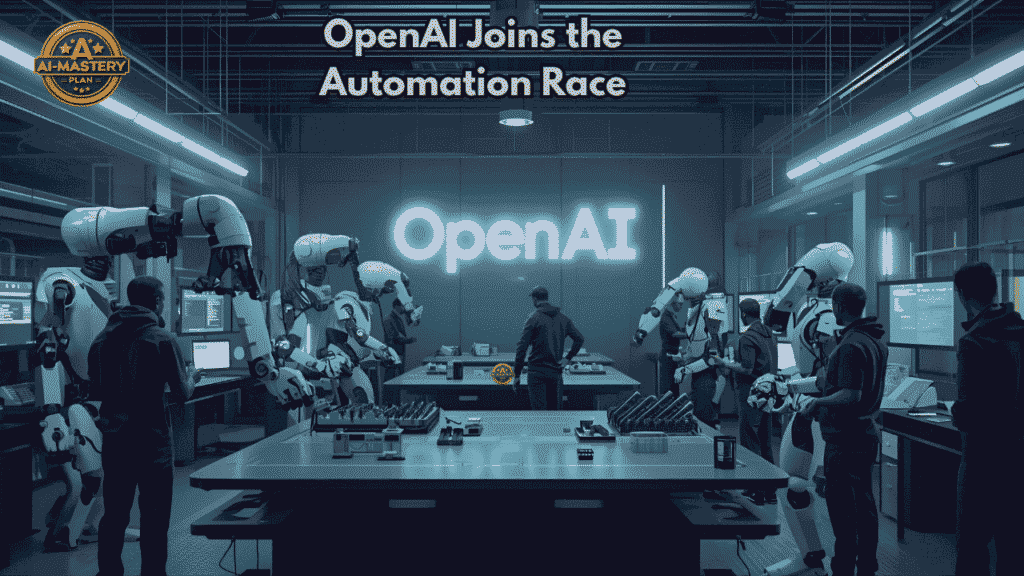
The Next Phase of AI: OpenAI Steps Into Robotics
The world’s most influential AI company, OpenAI, may be preparing for a new chapter — one that could redefine automation as we know it. According to multiple industry reports and expert analyses, OpenAI is quietly expanding its focus from pure software to robotics and real-world automation.
The move, if confirmed, would mark a major shift in the company’s mission — from developing digital intelligence to creating machines that can act, move, and respond like humans.
Recent reports suggest OpenAI is building a dedicated robotics division aimed at integrating its advanced language models with physical control systems. This means we may soon see robots powered not by simple scripts, but by human-like reasoning.
Why This Move Changes Everything
OpenAI’s expansion beyond screens is not just an upgrade — it’s a transformation. The company that gave the world ChatGPT is now aiming to merge artificial intelligence with mechanical motion, creating a new generation of autonomous systems capable of performing physical tasks.
Insider data reveals a significant increase in OpenAI’s hiring for robotics and mechatronics roles. The company has also begun exploring collaborations in simulation, teleoperation, and embodied AI, which are the key pillars of robotic intelligence.
Industry watchers believe this move positions OpenAI to directly compete with Tesla’s Optimus, Boston Dynamics, and Google DeepMind’s robotics research.
If OpenAI succeeds, it could become the first organization to create an ecosystem where AI not only thinks and speaks, but also moves and builds.
The Possible Impact on Global Industries
1. The New Automation Wave
Once limited to factories, automation is about to enter every part of daily life. From logistics to healthcare, and from home assistance to construction, AI-driven machines could take over repetitive, dangerous, and precision-based jobs.
2. The Future of Employment
This development reignites the global debate about job displacement. While AI tools have already reduced human involvement in digital work, physical automation may soon reshape the very structure of labor markets worldwide.
3. Economic and Ethical Challenges
Regulators are unprepared for a world where AI operates independently in physical environments. Questions of safety, accountability, and control remain unanswered. If an autonomous robot fails or causes harm, who will be responsible — the company, the operator, or the algorithm?
4. The Race for Dominance
The competition to merge AI with robotics is intensifying. Tesla, OpenAI, and a new wave of startups are now fighting to lead what many experts call the second industrial revolution.
Experts Weigh In
According to analysts at Wired and Reuters, OpenAI’s robotics ambitions are part of a broader plan to achieve Artificial General Intelligence (AGI) — not just a model that understands text, but a system that perceives, interacts, and learns from the world.
Tech policy researchers warn that this race could redefine human roles in the economy. The key question, they say, is not whether AI will take over, but how soon.
Economist Rachel Lerman commented, “The automation race is no longer about convenience — it’s about control. Whoever wins this phase will shape the global economy for decades.”
Preparing for the Future
As the line between digital and physical AI blurs, skill development becomes critical. Workers will need to master new areas such as robotic systems management, AI maintenance, and human-machine collaboration.
The coming years will favor adaptability, creativity, and emotional intelligence — traits that remain uniquely human.
The Bottom Line
OpenAI’s rumored entry into the automation race could mark the beginning of a new industrial age. This isn’t just about machines replacing humans — it’s about the fusion of intelligence and movement, a transformation that could redefine the global workforce.
The world is watching, and one thing is clear:
Artificial intelligence is no longer confined to the screen — it’s stepping into the real world.
Explore more guides on skill development and future-ready careers.