
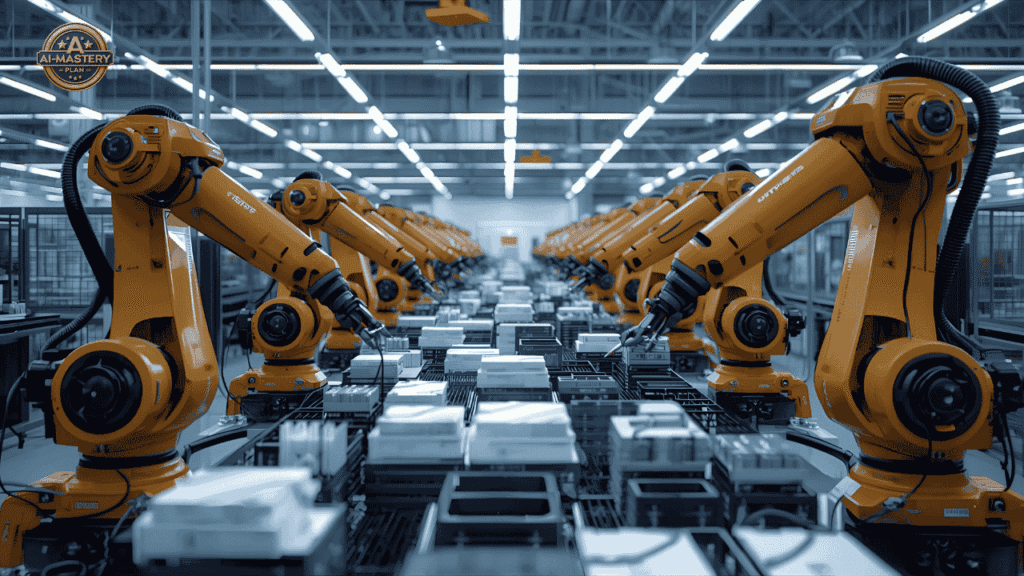
China has long been known as the world’s manufacturing powerhouse. From electronics to cars, it produces a large portion of the goods the world uses every day. But things are changing. On 28 September 2025, reports highlighted that the deployment of factory robots across Chinese industries has surged dramatically. Automation is no longer optional—it’s becoming central to China’s manufacturing strategy.
This article will explore why China is adopting robots so quickly, how it affects workers and the economy, and what it means for the rest of the world.
Why China Is Accelerating Automation
Several factors are driving the fast adoption of robots in China:
- Rising labor costs – Over the past decade, wages for factory workers have steadily increased. Robots offer a long-term solution by working 24/7 without breaks or holidays.
- Global competition – Countries like Vietnam, India, and Mexico provide cheaper labor. To stay competitive, Chinese factories are turning to automation.
- AI integration – Modern robots are smarter and can adapt to different tasks. They can inspect products, fix errors, and even learn new processes.
- Resilience after the pandemic – COVID-19 exposed weaknesses in human-dependent production lines. Robots keep factories running even during disruptions.
These reasons show why China is leading the world in factory robot deployment.
How Robots Are Changing Factories
A modern Chinese factory looks very different from ten years ago. Human workers are often replaced or assisted by machines.
- Automotive factories – Robots now handle welding, painting, assembling, and even inspecting vehicles.
- Electronics factories – Precision robots solder tiny chips and assemble small components.
- Warehouses and logistics – Autonomous robots transport goods faster and more efficiently than humans.
The benefits are clear: fewer errors, faster production, and safer working conditions.
Economic Impact of Robotics
The economic benefits of robot deployment are significant:
- Higher productivity – Robots can operate continuously without fatigue.
- Lower long-term costs – While robots are expensive initially, they save money over time by reducing errors and labor costs.
- Global competitiveness – By using robots, China keeps its manufacturing edge over other countries.
Recent data shows that China now installs more industrial robots than any other country, accounting for over half of global deployments.
Challenges and Concerns
Despite the benefits, automation comes with challenges:
- Job displacement – Many factory workers may lose their jobs, especially those doing repetitive tasks.
- Skill gap – Factories need skilled engineers and technicians to operate, maintain, and program robots.
- High initial costs – Smaller factories may not afford robots, slowing their adoption.
- Dependence on technology – Robots can fail or be affected by cyberattacks, which may halt production.
How China Compares Globally
China is not the only country adopting automation:
- Japan focuses on precision robotics for electronics and cars.
- Germany uses smart factories with AI and IoT for flexible production.
- United States applies AI in manufacturing and logistics.
China’s strength is scale. The government supports robotics investments, enabling factories to deploy thousands of robots at once, unmatched by any other country.
The Future Outlook
Experts predict that by 2030, more than 70% of China’s large factories will be heavily automated. Robots will not only perform repetitive tasks—they will adapt, learn, and collaborate with humans.
Workers will transition to roles such as:
- Supervising and programming robots
- Solving complex production problems
- Managing quality control and efficiency
This shift will redefine the manufacturing workforce and the nature of industrial jobs.
Positive Effects of Automation
- Increased safety – Robots handle dangerous tasks, reducing workplace accidents.
- Consistency and quality – Machines produce uniform products with fewer errors.
- Global competitiveness – China can meet growing international demand for high-quality goods.
Challenges to Consider
Automation also presents social and economic challenges:
- Job uncertainty – Millions of workers will need retraining.
- Investment inequality – Smaller companies may struggle to compete.
- Technology dependence – Factories may be vulnerable to system failures or cyber threats.
Conclusion
China’s surge in factory robots marks a new chapter in global manufacturing. Automation promises efficiency, innovation, and competitiveness, but it also brings social and economic challenges.
For China, embracing robotics is necessary to maintain industrial dominance. For the rest of the world, it raises important questions: How will economies adapt? How will workers gain new skills? And how will global supply chains evolve?
As robots and humans work side by side, the next decade will reveal the true impact of this industrial revolution. One thing is clear: the age of human-robot collaboration has arrived.