
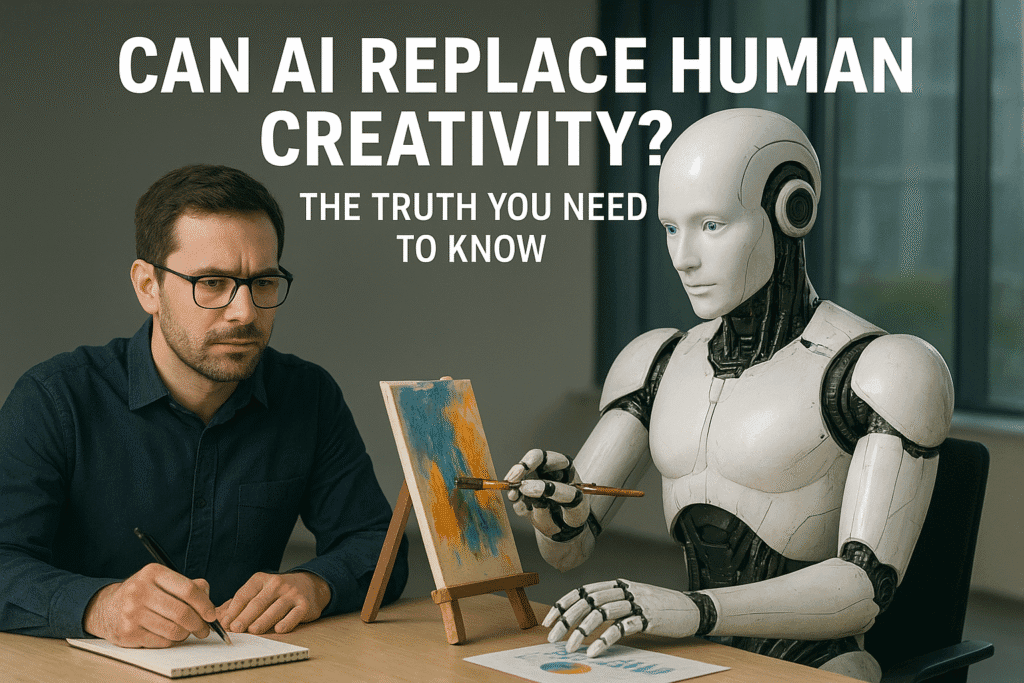
Artificial Intelligence (AI) is everywhere today. It writes stories, generates art, composes music, and even helps design products. This has raised a big question: Can AI replace human creativity?
While AI seems powerful, creativity is more than combining ideas. Creativity is imagination, emotion, experience, and purpose. AI can support creative work, but replacing true human creativity is another story. In this article, we’ll explore how AI and humans compare, where AI helps, and why our creativity remains unique and valuable in every field.
Understanding AI’s Creative Abilities
AI creates by learning patterns from existing data. For example, an AI trained on thousands of paintings can create a new image in the style of a famous artist. Similarly, AI tools can generate stories, poems, or music by mixing patterns it has learned.
But here’s the key: AI does not understand art or feel inspiration. It does not know joy, sadness, or ambition. Instead, it produces outputs that “look” creative because it mimics styles and structures.
So while AI sparks amazement, the question remains: does mimicking equal creativity?
What Makes Human Creativity Special
True creativity is not only producing something new. It’s about meaning and purpose. Humans create from emotions, struggles, hopes, and dreams. A song isn’t just notes in a pattern — it’s a story of love or loss. A painting is not just colors; it’s a message, often shaped by a life experience.
Core elements of human creativity include:
- Emotions and empathy: Humans create to connect.
- Conscious choice: We decide to break rules or traditions for innovation.
- Values and purpose: Creations can reflect culture, ethics, or visions of the future.
- Storytelling: Humans give context that machines cannot invent.
This depth is something AI cannot truly copy, because it lacks consciousness, experiences, and emotions.
Where AI Can Boost Creativity
Although AI cannot replace human imagination, it can enhance creative work. Many professionals already use it as a tool. Some examples include:
- Writers: AI suggests ideas, outlines, and draft text that people refine into meaningful stories.
- Designers: AI generates sketches, concepts, or layouts quickly, giving designers more starting points.
- Musicians: AI creates basic melodies for humans to adjust, improve, and personalize.
- Businesses: Teams use AI to analyze customer preferences and design products people actually love.
This shows that AI succeeds as a creative partner, not a creative replacement.
Benefits of Human-AI Collaboration in Creativity
Working side by side with AI offers clear advantages:
- Faster brainstorming – AI produces multiple ideas instantly that humans can refine.
- Breaking creative blocks – Staring at a blank page? AI can spark inspiration.
- Precision and detail – AI ensures accuracy in repetitive or technical aspects of art and design.
- Scalability – Businesses can launch designs or campaigns faster with AI’s help.
- Accessibility – Tools make creative opportunities open to more people, even without advanced training.
In short, AI is a helpful tool that frees us to focus on creativity’s deeper elements.
The Challenges of AI in Creative Work
With AI in creative spaces, challenges also arise:
- Originality concerns: AI outputs are based on existing work. This raises questions about real originality.
- Ownership and copyright: If AI produces art, who owns it — the user, the developer, or no one?
- Loss of human touch: Creativity without emotions may feel empty.
- Risk of over-dependence: Relying too much on AI tools may reduce personal creative effort.
For these reasons, the role of humans remains central. AI can support, but the heart of creativity still belongs to us.
Why Human Creativity Cannot Be Fully Replaced
Think about your favorite book, movie, or song. Would it feel the same if created by a machine? Probably not. That’s because human creativity includes experiences, struggles, culture, and values. AI cannot “live life” and therefore cannot express humanity through art or invention.
The future of creativity is not humans versus AI. It is humans supported by AI. We lead with vision, while AI provides ideas and efficiency. That is why the future is about collaboration, not replacement.
How to Use AI Without Losing Your Creativity
To stay ahead as AI grows, keep these tips in mind:
- Use AI as a helper, not a master – Let it spark ideas, but always add your voice.
- Strengthen your storytelling – Focus on depth, emotions, and inspiration that AI cannot replicate.
- Keep learning – Improve your creative process with training, tools, and practice. You can explore growth resources like the AI Mastery Plan.
- Balance your craft – Use AI to save time, but spend effort on originality and meaning.
- Improve human skills – Leadership, empathy, and vision will always make your creativity unique. You can also explore platforms that offer self-development.
Inspiration for Creators in the AI Era
Instead of fearing AI, think of it as your partner. AI can make creation faster and easier, but the soul of creativity is something no machine can touch.
Imagine these examples:
- A teacher uses AI to prepare engaging lessons but still inspires students through passion.
- An artist combines AI-generated drafts with her own touch to create a one-of-a-kind masterpiece.
- A small business owner runs ad campaigns with AI support but connects personally with customers through stories.
The possibilities are endless when you use AI wisely without losing your human spark.
Conclusion: The Irreplaceable Human Touch
So, can AI replace human creativity? The simple answer is no. AI can learn styles, suggest ideas, and even create impressive works. But real creativity is more than patterns. It is about meaning, empathy, and vision — all deeply human.
We should not fear AI. Instead, we should use it as a tool to amplify our imagination. The future belongs to creators who embrace technology but lead with heart, values, and purpose.
Your creativity will always be unique, because it comes from your lived experience. No machine can take that away.
FAQs: Can AI Replace Human Creativity?
1. Can AI create original art?
AI can generate new images or music, but it’s based on past patterns. True originality still needs human vision.
2. Does AI understand emotions in art?
No. AI processes data logically but does not feel emotion, joy, or pain. Human emotions drive true creativity.
3. How do professionals use AI in creative work?
They use it to save time, get ideas, and explore options. But they refine the work with their own imagination.
4. Could AI replace writers or artists?
AI may help create drafts or concepts, but artists and writers give meaning, depth, and uniqueness that machines cannot.
5. What is the biggest risk of AI in creativity?
Over-reliance. If people depend fully on AI, they may stop developing personal creative skills.
6. How can I use AI as a creative partner?
Use AI for inspiration and time-saving tasks, but always add personal touches, stories, and values.
7. Will future creativity belong to humans or AI?
The future belongs to collaboration. Humans provide purpose. AI provides speed and assistance.
8. Should I be worried AI will take over my creative career?
No. Focus on strengthening your human skills and using AI smartly. It can make your career stronger, not weaker.