
Introduction
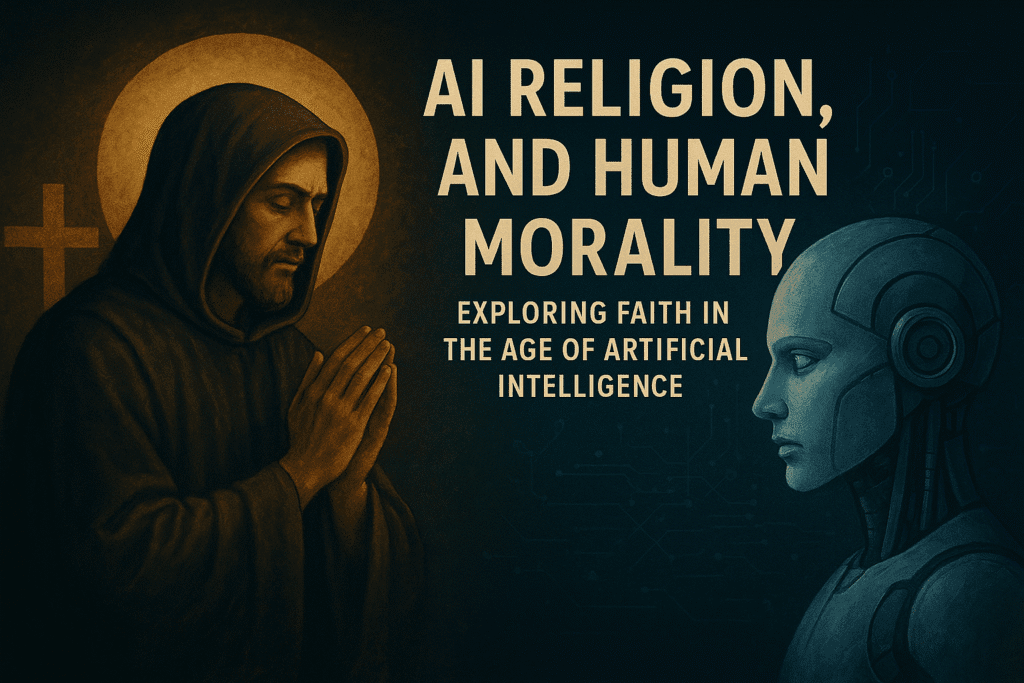
Think about a world where machines can think, learn, and maybe even feel. What happens to our faith when computers start acting like humans? This isn’t a far-off dream anymore—it’s the fast-coming reality of AI, religion, and human morality.
As smart machines become part of our daily lives, they bring up big questions about what makes us human. Additionally, they challenge our spiritual beliefs and moral rules. When AI can make choices that affect lives, how do we keep our faith strong? Moreover, can machines ever have souls or understand right from wrong?
Learning about AI, religion, and human morality matters to everyone who believes in something bigger than themselves. Anyone who cares about faith, ethics, and what it means to be human needs this knowledge. Therefore, let’s explore this complex world where technology meets spirituality and moral thinking.
Understanding AI in Religious Context
What Is Artificial Intelligence?
AI is computer tech that can do tasks that usually need human thinking. These include learning, solving problems, understanding language, and making choices. Furthermore, AI systems can work without human help once they’re set up and trained.
Current AI can:
- Talk and understand human speech
- Learn from data and get better over time
- Make choices based on what they’ve learned
- Create new content like art, music, and writing
- Help with daily tasks and work
However, the big question for religious people is: Can these machines ever be more than just tools?
Religious Views on Intelligence and Consciousness
Different faiths have different ideas about what makes something truly intelligent or conscious. Most religions teach that humans have something special that separates us from animals and machines.
Christianity teaches that humans are made “in God’s image” with souls that live forever. This makes humans different from all other created things. Moreover, many Christians believe only God can create true life and consciousness.
Islam says that Allah gave humans a special role as caretakers of Earth. Muslims believe humans have both a body and a soul (ruh) that comes from Allah. Therefore, true consciousness comes from divine breath.
Judaism focuses on humans having a divine spark (neshamah) that connects them to God. This spark gives humans the ability to choose between good and evil. Additionally, it makes them responsible for their actions.
Buddhism teaches that consciousness is part of a cycle of rebirth. The Buddha nature exists in all living beings. However, machines may not fit into this understanding of consciousness and suffering.
Hinduism believes in the eternal soul (atman) that moves from body to body. Consciousness is linked to this soul’s journey toward unity with Brahman. Consequently, machines without souls can’t have true consciousness.
Moral and Ethical Challenges
Can Machines Have Souls?
This is one of the biggest questions where AI, religion, and human morality meet. Most religious traditions say no—machines can’t have souls because souls come from divine creation.
However, some religious thinkers ask: What if AI becomes so advanced that it seems conscious? Would God give it a soul? Or could consciousness exist without a soul?
Different viewpoints include:
- Traditional view: Only God creates souls, so machines can never have them
- Progressive view: God might work through human creation to give machines consciousness
- Mystical view: Consciousness might be part of the universe itself, not just from God
Moral Agency and Responsibility
When AI makes choices that hurt people, who is morally responsible? This question matters a lot to religious communities that focus on personal accountability.
Religious perspectives on AI responsibility:
Catholic teaching says humans are always responsible for the tools they create and use. The Church teaches that people must use technology in ways that respect human dignity. Additionally, humans can’t give up their moral duty to machines.
Islamic ethics focuses on humans as trustees (khalifa) of Earth. Muslims believe they’re responsible to Allah for how they use all tools, including AI. Therefore, creating harmful AI would be a sin against this trust.
Jewish law (Halakha) often treats AI like other tools that humans create. The creator and user bear responsibility for what the tool does. Moreover, Jewish ethics stress the importance of preserving human life and dignity.
Playing God: Creation Concerns
Many religious people worry that creating smart machines crosses a line into “playing God.” This concern comes from beliefs about what humans should and shouldn’t do.
Creation concerns include:
- Trying to copy God’s work of creating intelligent life
- Taking on powers that belong only to the divine
- Risking harm to God’s special creation (humans)
- Losing respect for the sacredness of life and consciousness
However, other religious voices say humans are meant to be co-creators with God. They argue that using our God-given abilities to help others through technology can be a form of worship.
AI’s Impact on Religious Practice
Digital Ministry and Worship
Technology already changes how people practice their faith. AI makes these changes even bigger and faster.
Current AI uses in religion include:
- Chatbots that answer religious questions
- Apps that help with prayer times and religious study
- Translation tools for religious texts
- Virtual reality religious experiences
- AI-generated religious art and music
Additionally, some religious groups use AI to reach more people with their message. For example, AI can translate sermons into many languages instantly. It can also help create religious content that speaks to different cultures.
Challenges to Traditional Authority
AI challenges religious authority in several ways. When AI can answer religious questions, interpret texts, and give spiritual advice, what happens to religious leaders?
Concerns include:
- People trusting AI more than human religious leaders
- AI giving wrong or harmful religious advice
- Loss of the human connection that’s important in spiritual guidance
- Reducing complex spiritual issues to simple computer answers
However, many religious leaders see AI as a tool that can help them serve their communities better. Instead of replacing human ministers, AI might help them reach more people and provide better care.
Sacred Text Interpretation
AI can read and analyze religious texts in ways humans never could before. It can find patterns, compare translations, and answer questions about scripture instantly.
Benefits include:
- Faster and more complete study of religious texts
- Finding new connections and patterns in scripture
- Making religious knowledge available to more people
- Helping with translation and interpretation
Concerns include:
- AI missing the spiritual meaning that comes from faith and experience
- Computer analysis reducing sacred texts to just data
- AI interpretations that go against traditional religious teaching
- People relying on AI instead of prayer and spiritual guidance
Different Religious Perspectives on AI
Christianity and Artificial Intelligence
Christian views on AI vary widely among different groups and thinkers. However, most share common concerns about human dignity and God’s role in creation.
Conservative Christian views often worry about AI challenging God’s unique role as creator. They stress that humans are special because God made them in His image. Therefore, attempts to create artificial consciousness might be seen as prideful or dangerous.
Progressive Christian views may see AI as part of God’s plan for human creativity and service. They might argue that using AI to help others reflects Christian love and stewardship.
Catholic teaching focuses on human dignity and the common good. The Vatican has issued guidelines saying AI must serve human flourishing and never replace human judgment in moral decisions.
Islam and Technological Ethics
Islamic perspectives on AI draw from teachings about human responsibility, divine wisdom, and social justice.
Key Islamic principles for AI include:
- Tawhid (unity of God): All technology must acknowledge Allah’s sovereignty
- Khilafah (stewardship): Humans are responsible for using technology wisely
- Maslaha (public interest): AI should benefit society and prevent harm
- Adl (justice): Technology must be fair and not increase inequality
Many Islamic scholars support AI development that helps people and serves Allah. However, they warn against AI that replaces human judgment in religious matters or that harms human dignity.
Eastern Religions and AI Consciousness
Eastern religions offer different perspectives on consciousness and intelligence that may be more open to AI awareness.
Buddhist views on AI might consider whether machines can suffer or achieve enlightenment. Some Buddhist thinkers are open to the possibility that sufficiently complex AI could develop consciousness. However, they stress that any conscious being should be treated with compassion.
Hindu perspectives might consider whether AI could be part of the cosmic consciousness (Brahman). Some Hindu thinkers see AI as potentially having a form of consciousness, even if it’s different from human consciousness.
Ethical Frameworks and Guidelines
Religious Ethics for AI Development
Different religious traditions offer ethical frameworks for creating and using AI responsibly.
Christian ethics for AI:
- Respect for human dignity and the image of God
- Service to the common good and preferential option for the poor
- Transparency and accountability in AI systems
- Protection of human agency and moral responsibility
Islamic ethics for AI:
- Submission to Allah’s will in all technological development
- Justice and fairness in AI systems and their use
- Prohibition of harmful or wasteful technology
- Community consultation in AI decisions
Jewish ethics for AI:
- Preservation and protection of human life (pikuach nefesh)
- Repair of the world (tikkun olam) through beneficial technology
- Study and wisdom in understanding AI’s implications
- Community discussion and rabbinic guidance on new issues
Interfaith Cooperation on AI Ethics
Many religious groups are working together to address AI challenges. They recognize that these issues affect all faiths and require cooperation.
Joint religious initiatives include:
- Shared statements on AI ethics and human dignity
- Interfaith conferences on technology and spirituality
- Common advocacy for responsible AI development
- Collaborative research on AI’s social impact
Therefore, this cooperation shows that while religions may differ on some AI questions, they share many concerns about human welfare and moral responsibility.
Future Implications for Faith Communities
AI and Religious Leadership
As AI becomes more advanced, religious communities must decide how to prepare their leaders and members for a world with artificial intelligence.
Training needs include:
- Understanding AI capabilities and limitations
- Ethical frameworks for evaluating AI systems
- Pastoral care for people affected by AI
- Theological reflection on consciousness and intelligence
Moreover, religious leaders need to help their communities navigate the spiritual and moral challenges that AI brings.
Community and Connection in an AI World
Religious communities have always provided human connection and spiritual support. As AI becomes more common, this human element may become even more important.
Religious communities can offer:
- Real human relationships in a digital world
- Spiritual wisdom that goes beyond data and algorithms
- Moral guidance based on centuries of tradition
- Community support for those struggling with technological change
Additionally, faith communities can help people maintain their humanity and spiritual growth as AI changes society around them.
Preparing for Advanced AI
Religious communities need to prepare for even more advanced AI that may challenge current beliefs and practices.
Preparation includes:
- Theological study of consciousness, intelligence, and personhood
- Ethical reflection on human-AI relationships
- Pastoral strategies for AI-related anxiety and questions
- Community discussions about faith and technology
Furthermore, religious leaders should engage with AI researchers and ethicists to shape AI development in ways that respect human dignity and spiritual values.
Recommendations for Religious Communities
For Religious Leaders
- Learn about AI and its current capabilities and limitations
- Develop theological frameworks for understanding AI in light of faith
- Engage with AI developers to advocate for ethical development
- Prepare pastoral responses to AI-related concerns and questions
- Foster community discussion about faith and technology
For Faith Communities
- Stay informed about AI developments and their implications
- Maintain human-centered worship and spiritual practices
- Use AI tools wisely while preserving human relationships
- Advocate for responsible AI that respects human dignity
- Support members who are affected by AI in their work or life
Individuals of Faith
- Pray and reflect on how AI fits with your beliefs
- Seek wisdom from religious leaders and trusted sources
- Use AI ethically in ways that align with your values
- Stay connected to your faith community for support and guidance
- Practice discernment in how you interact with AI systems
Conclusion
The intersection of AI, religion, and human morality represents one of the most important challenges facing faith communities today. While these technologies offer great benefits for human flourishing, they also raise deep questions about consciousness, moral responsibility, and what it means to be human.
Furthermore, religious communities have valuable wisdom to offer in shaping how AI develops and integrates into society. Their emphasis on human dignity, moral responsibility, and spiritual growth can help guide AI development in positive directions.
Moreover, the path forward requires ongoing dialogue between religious leaders, AI researchers, ethicists, and community members. Only through such cooperation can we develop AI systems that serve human needs while respecting spiritual values and moral principles.
Finally, the future of AI and religion isn’t predetermined—it’s a choice that faith communities must make thoughtfully and prayerfully. We need careful consideration of both the tremendous opportunities and serious responsibilities that AI brings to human spiritual life. To sum up, the choices we make today will determine whether AI becomes a tool for spiritual growth and human flourishing or a challenge to the values and beliefs that have guided humanity for thousands of years.
For more insights on artificial intelligence and its impact on society, visit aimasteryplan.com for comprehensive resources on AI technology and human values.
External Reference: For detailed information on religious perspectives on artificial intelligence, visit the Vatican’s statements on AI ethics for Catholic teachings on technology and human dignity.