
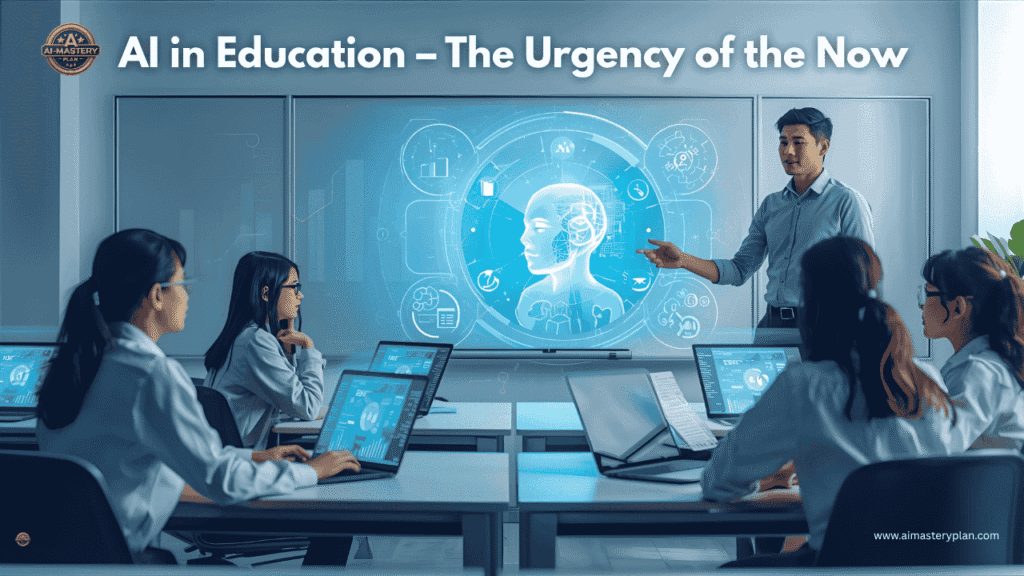
Artificial Intelligence is no longer the future of education — it’s already shaping classrooms, lessons, and learning outcomes today.
A new study by Leonardo Lab of Bocconi University, shared via Thinkers360, highlights one urgent truth: the world’s education systems are not adapting fast enough to AI’s rapid influence.
The paper, titled “AI in Education – The Urgency of the Now,” calls on educators and policymakers to act immediately before the technology outpaces teaching itself.
AI Is Reshaping the Learning Experience
From adaptive study platforms to AI tutors, education is undergoing a structural shift.
According to the report, tools like ChatGPT, Khanmigo, and Duolingo Max are already enabling personalized learning experiences that adjust to every student’s speed and skill level.
AI-driven analytics are helping teachers identify struggling students in real time, enabling early intervention and targeted teaching.
Meanwhile, administrative tasks such as grading and report generation are becoming fully automated — allowing teachers to focus on creativity, mentorship, and human connection.
The authors describe AI as “the first major opportunity to rebuild education around the learner rather than the system.”
Challenges: Ethics, Inequality, and AI Dependence
However, the paper warns that the excitement around AI’s potential hides significant risks.
Data privacy concerns remain at the top of the list — especially when AI systems process student performance and behavioral patterns.
Many schools also face an unequal AI landscape: elite institutions can afford premium AI-powered platforms, while public and rural schools lag behind.
The result could be a new kind of digital divide — one based not on internet access, but on AI literacy.
Teachers, too, are struggling to keep pace.
Few training programs currently teach educators how to use or supervise AI tools effectively.
As the paper notes, “Technology is learning faster than teachers are being trained.”
The Human Role in the Age of AI Classrooms
Despite automation, experts agree that the teacher’s role remains irreplaceable.
AI can process knowledge, but only humans can guide learning with empathy, ethics, and judgment.
Bocconi University’s researchers recommend a blended approach — where AI handles personalization and data analysis, while teachers handle creativity, critical thinking, and emotional intelligence.
They argue that this human-AI partnership could produce the most effective classrooms in history, as long as ethical guidelines and accountability remain central to implementation.
Lessons for Educators and Policymakers
The report outlines key lessons for schools and governments:
- Teach AI Literacy Early: Students should learn how AI works and how to use it responsibly.
- Train Teachers Continuously: Educators need structured programs to learn AI integration, not one-off workshops.
- Set Clear Data Ethics Rules: Schools must protect student information and prevent misuse.
- Encourage Critical Thinking: AI should assist learning, not replace reasoning or creativity.
In short, the goal is not to replace teachers with technology, but to retrain and empower them for an AI-enhanced future.
The Urgency of the Now
The Bocconi University team concludes that the education sector has a two-to-three-year window to adopt responsible AI strategies before the technological gap becomes too wide to close.
“Those who wait will teach outdated skills,”
the authors warn.
“Those who act now will prepare the generation that defines the AI era.”
The message is clear — AI in education is not optional anymore; it’s essential.
Final Thought
AI brings extraordinary potential to democratize education, but it demands courage, ethics, and vision from today’s leaders.
As the world’s classrooms evolve, the urgency of the now is no longer about adopting technology — it’s about ensuring humanity leads it responsibly.
Frequently Asked Questions (FAQs)
AI in Education – The Urgency of the Now
1. What does “AI in Education – The Urgency of the Now” mean?
It refers to the immediate need for educators and policymakers to adopt AI tools in teaching and learning before the technological gap becomes too large to close.
2. How is AI currently being used in classrooms?
AI is being used for personalized learning, automated grading, student analytics, and virtual tutoring through platforms like ChatGPT, Duolingo Max, and Khanmigo.
3. Why is AI important in modern education?
AI helps teachers understand individual learning patterns, provides real-time feedback, automates administrative work, and enables students to learn at their own pace efficiently.
4. What are the main challenges of AI in education?
Key challenges include data privacy, unequal access to AI tools, teacher training gaps, and the ethical use of AI-generated content by students.
5. Can AI replace teachers in the future?
No. AI can support and enhance education, but human teachers remain essential for critical thinking, creativity, ethics, and emotional guidance in classrooms.
6. How can teachers prepare for AI integration?
Educators should develop AI literacy, attend digital training programs, experiment with classroom AI tools, and understand how to guide students in responsible AI usage.
7. What ethical issues come with using AI in education?
Ethical concerns include data misuse, algorithmic bias, over-reliance on automation, and ensuring fairness and transparency in AI-powered evaluations.
8. How does AI support personalized learning?
AI tailors lessons to each student’s pace, strengths, and weaknesses, allowing for adaptive quizzes, custom feedback, and individualized progress tracking.
9. What are the long-term benefits of AI in education?
Long-term benefits include more efficient schools, higher engagement, reduced workload for teachers, and improved access to quality learning for all students.
10. What actions should schools take now?
Schools should start integrating AI literacy into curricula, train teachers regularly, set ethical data policies, and collaborate with technology experts to future-proof education.