
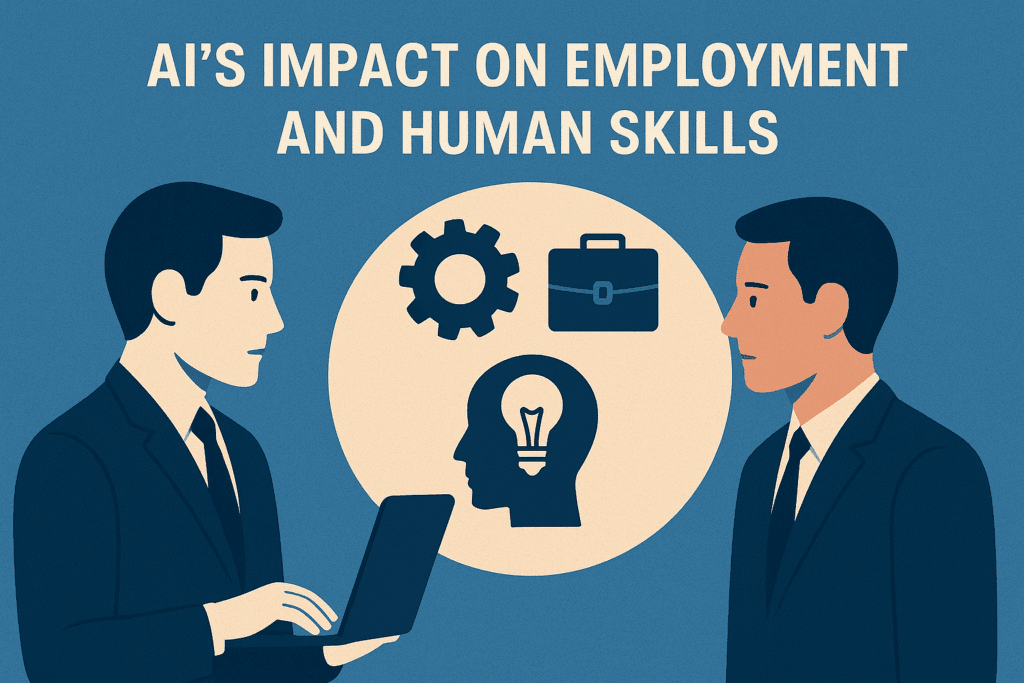
Artificial Intelligence (AI) is everywhere today. It helps doctors read scans, powers chatbots in stores, and supports companies with quick decisions.
But here’s the big question: What will AI do to jobs and human skills?
Some worry it will take away work. Others see it as a chance to grow. The truth is that AI is already changing how people work. To keep up, we need to understand its impact and get ready for what’s next.
1. Two Sides of AI and Work
AI is like a tool with two sides. One side brings efficiency. It can do boring, repeated work in seconds. The other side creates fear. People with routine jobs often wonder: “Will AI replace me?”
For example, machines now build cars faster than workers. Banks use AI to catch fraud. Supermarkets use self-checkout systems instead of cashiers.
But history shows something important. Each new technology removed some jobs but created others. In fact, AI is already creating roles that never existed before.
2. Jobs Most Affected by AI
Not all jobs face the same risk. The roles most exposed are those with repeated tasks that are easy to predict.
- Transport: Self-driving vehicles may reduce drivers.
- Retail: Automated checkouts reduce cashier work.
- Customer Support: Chatbots answer simple questions without humans.
- Finance: Software handles risk checks and loan approvals.
- Clerical Work: Machines read and enter data faster.
Still, not every role disappears. Instead, many jobs will evolve while humans focus on tasks machines cannot do.
3. Skills AI Cannot Replace
AI is powerful, but it cannot replace people in every way. The most valuable skills in the future are the ones only humans bring.
- Creativity – Making new ideas or art.
- Problem-solving – Looking at complex issues and finding fair solutions.
- Emotional intelligence – Understanding feelings and showing empathy.
- Adaptability – Changing quickly when things shift.
- Teamwork and Leadership – Inspiring and guiding others.
Therefore, the future is not about competing with AI, but about growing human strengths.
4. New Jobs Created by AI
As some jobs fade, new paths rise. AI is not just replacing old roles. It also creates entirely new ones.
- AI Trainers – People who teach AI using data.
- AI Ethics Experts – Advisors making sure AI is fair and safe.
- Data Engineers – Builders who design AI systems.
- Human–AI Coordinators – Workers managing teamwork between people and machines.
- Skill Coaches – Trainers who help employees prepare for new roles.
This change shows that work is shifting, not ending.
5. How to Prepare for AI at Work
Adapting to AI is possible. You just need the right approach. Here’s how:
- Learn new skills often – Online courses, like those on For More Improvement, are useful.
- Develop soft skills – Focus on creativity, speaking, teaching, and leadership.
- Stay informed – Guides like AI Mastery Plan explain AI in simple ways.
- Be flexible – Career paths will change over time.
- Work with AI, not against it – Use it as a tool, not a threat.
As a result, people who combine tech awareness and human skills will succeed.
6. A Change in Mindset
AI frees us from repetitive jobs. This gives us more time for real human work.
For example, a teacher can spend less time on grading and more time guiding students. A doctor may use AI for fast scanning but still focus on personal care.
In other words, AI is not taking away meaning. It lets us do more meaningful tasks.
7. Governments and Companies Have a Role
Workers are not the only ones responsible for adapting. Governments and companies also play key roles.
- Governments must create rules, training programs, and protections for workers.
- Companies should teach staff how to use AI and guide them during changes.
Together, they can make sure AI helps workers instead of harming them.
8. The Positive Side of AI
Yes, change can be scary. But change also holds great promise.
AI handles heavy data work. People get more time for creative projects, building relationships, and solving tough problems.
Imagine cities designed for smarter living, doctors solving world health issues, and artists growing new cultures. All of this is possible when humans and AI work together.
AI doesn’t close doors. Instead, it opens new ones.
Conclusion
AI is reshaping jobs and skills. Some roles may fade away, but many new ones are being created. The workers who succeed will not just know technology — they will master their human skills too.
Stay curious. Keep learning. Build empathy, creativity, and adaptability. AI may be smart, but humans are still the most valuable part of the workplace.
Always remember: AI is a tool. People are the decision-makers.
FAQs
1. Will AI replace all jobs?
No. It will remove some, but it will also create new ones.
2. What jobs are most at risk?
Driving, clerical work, cashiers, and basic customer support.
3. Which human skills matter most?
Creativity, leadership, adaptability, empathy, and problem-solving.
4. How do I prepare for AI changes?
Learn new skills, improve soft skills, and stay flexible.
5. Can AI fully replace doctors or teachers?
No. AI helps them, but empathy and care are human.
6. What can governments do?
Create laws, support retraining, and protect workers.
7. Is AI good for small businesses?
Yes. It helps with marketing, inventory, and customer support.
8. Can AI make people more productive?
Yes. It takes boring tasks away, leaving humans with creative work.
9. Should I be afraid of AI?
No. Stay positive, keep learning, and see it as a partner.