
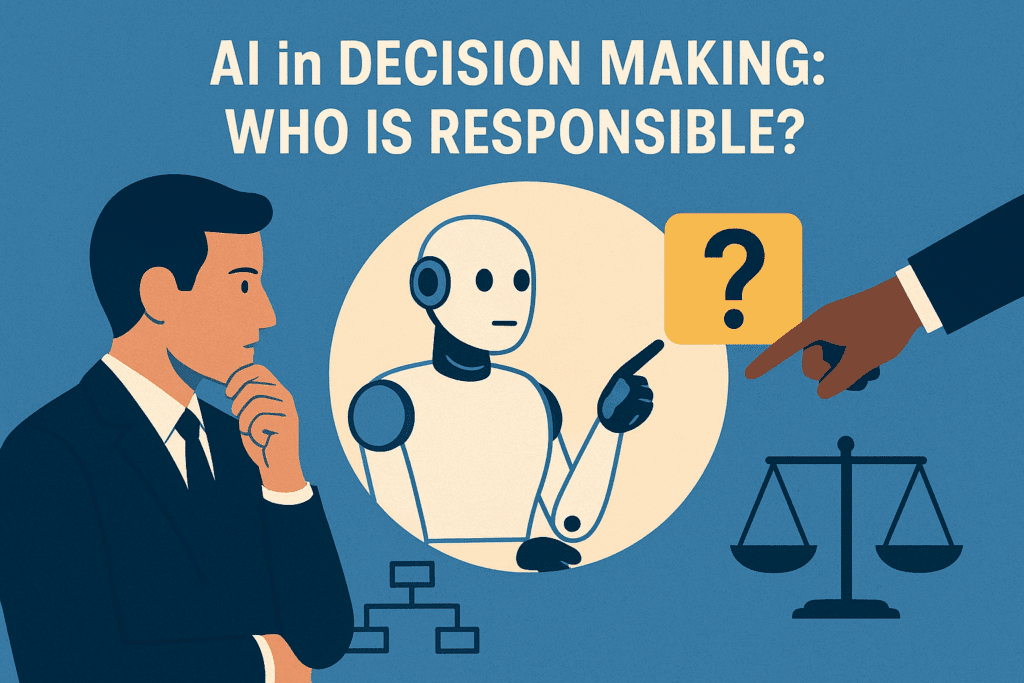
Artificial Intelligence (AI) is shaping the way decisions are made in every part of life. Businesses use it to find customers. Doctors use it to study medical images. Banks use it to approve loans. Even governments use AI to predict risks.
This is powerful. AI can process information faster than people and often spot patterns humans may miss. But one question always comes up: If AI makes a decision, or worse, a mistake, who is responsible?
This is more than a tech issue. It is also about ethics, law, and trust. Let’s look at why responsibility matters, who carries it, and how we should prepare for an AI-powered future.
1. Why AI Is Used in Decision Making
AI helps solve problems that require processing large amounts of information. For example:
- Spotting fraud in financial transactions
- Recommending medicine based on symptoms
- Helping managers choose the best candidate for a job
- Predicting weather patterns
- Suggesting products to customers online
The benefit is clear: more speed, more consistency, and sometimes more fairness. Still, the bigger the use of AI, the bigger the question of responsibility.
2. The Responsibility Gap
Here’s the problem. When a person makes a wrong choice, we know who is to blame. But when a machine does it, it’s not so simple.
Think about a self-driving car. If it causes an accident, who is at fault — the passenger, the car maker, or the software developer?
This gap in responsibility is one of the biggest challenges with AI. Machines don’t feel regret or guilt. They also don’t carry moral judgment. Responsibility must fall on humans.
3. Humans vs Machines
AI is not a replacement for people. It should be seen as a support tool. Humans have to be responsible because:
- We build AI. Every program is written, designed, and trained by people.
- We provide the data. If the dataset is biased, the output will also be biased.
- We set the goals. AI does what it is asked to do.
So, while the machine helps, responsibility must remain with us. The golden rule is: AI helps, but humans decide.
4. Responsibility Across Fields
Healthcare
AI can suggest treatments, but a doctor makes the final call. If an error hurts a patient, the medical professional is responsible — not the machine.
Business and Hiring
If an algorithm unfairly rejects applicants, the company is at fault. Leaders must check the system for bias.
Finance
Banks sometimes use AI to approve or deny loans. Still, regulators will always hold the bank responsible if the system treats customers unfairly.
Transportation
In the case of self-driving cars, liability usually points to the designers or manufacturers. They must ensure safe systems before putting them on the road.
5. Why Transparency Matters
One of the biggest risks in AI is the “black box” problem. Often, people don’t know why a system gave a certain answer. This makes it hard to check decisions.
To keep trust, companies should:
- Explain how AI results are produced in simple terms
- Share how systems are trained
- Regularly test algorithms for bias and errors
Transparency supports trust. Without it, fairness is impossible.
6. Ethics: Beyond Laws
There’s also ethical responsibility. Even if a law does not exist yet, people and companies must ask:
- Could this system cause harm?
- Is it fair to everyone?
- Might it take away jobs without better options?
Ethics means looking at the human cost, not just profit or efficiency.
7. How to Use AI Responsibly
Here are some practical steps to make AI work fairly and safely:
- Keep humans in the loop. AI should guide decisions, not make them alone.
- Clean the data. Poor-quality data leads to poor-quality results.
- Define roles clearly. Always assign accountability to humans.
- Audit regularly. Test systems often to catch bias or mistakes.
- Educate users. Train professionals on how AI makes decisions.
- Follow global guidelines. Use global ethical rules to guide choices.
If you want to learn more about how to master AI in a responsible way, check out AI Mastery Plan, which covers both benefits and risks in simple terms.
8. Why This Matters to You
AI is not just about machines. It is about people, choices, and the future of work. Every AI-supported decision — whether about a job, a loan, or a medical test — impacts real lives.
That’s why your role is important, whether you’re a student, employee, or leader. Learn enough about AI to spot its risks and strengths. Use it with care, knowing the final call is always yours.
If you want to keep improving your skills for tomorrow, you can also explore opportunities designed for continuous growth.
9. Conclusion
AI gives us speed and insight, but not human judgment. Machines will never carry moral weight. Responsibility for decisions must stay with people.
By combining human oversight, transparency, and ethics, we can shape AI into a tool that supports society. If misused, it could harm more than it helps. But if guided wisely, it has the power to solve real challenges.
Always remember: AI assists. Humans decide. Responsibility stays with us.
FAQs
1. Can AI make decisions by itself?
Yes, but these decisions are based on data and rules created by humans.
2. If AI makes a mistake, who is accountable?
The human team or organization that built or deployed the system.
3. Can AI ever be fully fair?
Not fully. But with diverse data and regular testing, results can get fairer.
4. Should we fully trust AI in medicine?
No. It should help doctors, but judgment must remain with the doctor.
5. What role do governments play?
They create policies and laws to protect citizens from harmful AI decisions.
6. How can workers prepare for AI?
By learning how AI tools work and staying updated through training and guides like AI Mastery Plan.
7. Why care about this topic if I don’t work in tech?
AI already affects hiring, finance, healthcare, and education. Its decisions influence everyone’s daily life.