
Baltimore, Maryland — October 27, 2025:
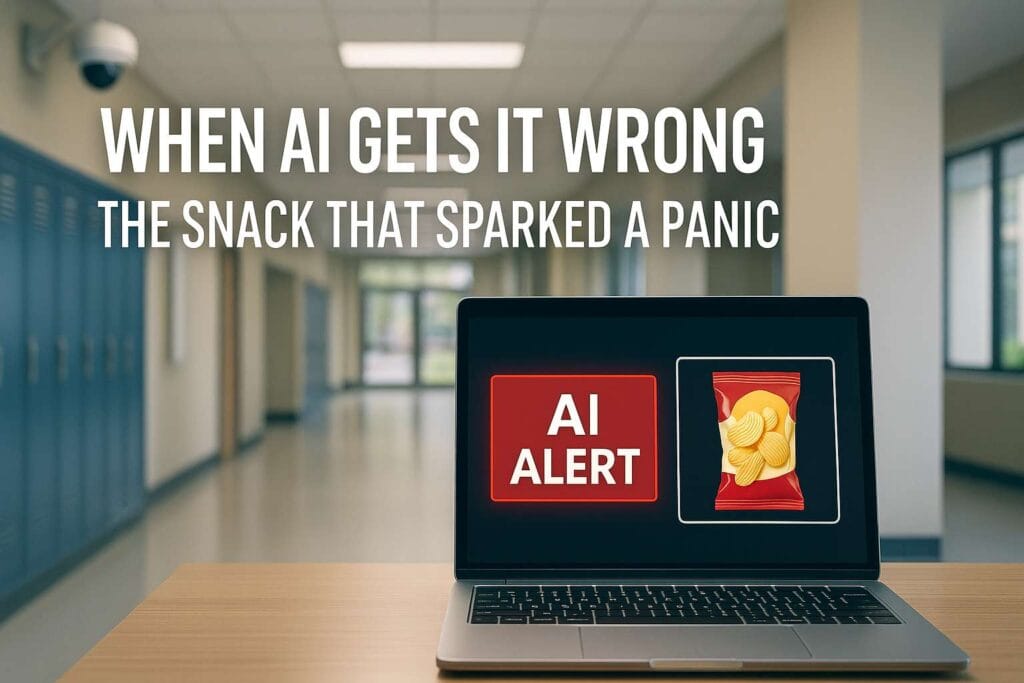
A quiet afternoon at Kenwood High School turned into a full-blown police operation when an AI-powered gun detection system wrongly identified a bag of chips as a firearm.
Sixteen-year-old Taki Allen was leaving class when armed officers suddenly surrounded him, ordering him to drop his “weapon.” Moments later, the truth surfaced — the supposed gun was just a foil Doritos bag reflecting light.
The incident, now viral across social media, has reignited a growing debate: Can artificial intelligence really be trusted with public safety?
The False Alarm That Sparked Chaos
Kenwood High, located in Essex, Maryland, had recently installed a sophisticated AI security tool developed by Omnilert, designed to scan school cameras for potential weapons.
On that day, the system issued an instant alert after detecting what it believed was a handgun. Within minutes, multiple police vehicles arrived on campus. Bodycam footage later released by Baltimore County Police shows officers aiming weapons and handcuffing the student before realizing the alert was false.
A school spokesperson said, “The AI system did exactly what it was programmed to do. The response followed protocol — but fortunately, no one was harmed.”
A Machine’s Mistake — A Human Scare
AI experts say the system’s failure likely stemmed from its pattern-recognition model, which can confuse harmless objects with weapons based on color, angle, or reflection.
Dr. Maya Reynolds, a computer vision researcher at Johns Hopkins University, explained:
“AI doesn’t understand reality — it only interprets pixels. A shiny, rectangular object can easily be flagged as a gun if it shares visual similarities.”
Although AI detection systems have been credited with preventing real threats, this case highlights their vulnerability to false positives — errors that can cause chaos in seconds.
Social Media Outrage and Public Fear
Once footage of the handcuffed teen spread online, outrage followed. Hashtags like #AIFailure and #SchoolSafety trended on X (formerly Twitter), with users calling the event “a terrifying glimpse of our AI future.”
One viral post read:
“A kid nearly got shot because an algorithm can’t tell chips from a gun. That’s not safety — that’s automation gone wrong.”
Others defended the system, saying false alerts, while unfortunate, are part of learning to integrate AI responsibly. “It’s better to overreact than underreact,” one parent commented.
Company’s Response and Investigation
In a statement, Omnilert said it was reviewing the incident and would “retrain its algorithm to better differentiate reflective surfaces and everyday objects.”
The company added:
“Our platform assists human operators — it does not replace them. We are working with Baltimore County officials to ensure every alert is verified before police action.”
However, privacy advocates warn that such incidents could erode public trust in AI surveillance technologies, especially when they lead to unnecessary police confrontations involving minors.
Experts Warn of Over-Reliance on AI in Schools
The Kenwood case underscores a growing tension in U.S. schools: balancing safety with privacy and human judgment.
Civil rights advocate James Warren said the problem lies not just in the software but in society’s blind faith in it.
“When schools start treating AI alerts as truth, they stop thinking. A child almost got hurt today because a machine was believed over common sense.”
Education policy researchers are calling for stricter guidelines before schools adopt high-risk AI tools, suggesting mandatory human review for every alert.
The Human Cost Behind a Digital Error
For Taki Allen, the experience was more than just a technical glitch — it was trauma.
“I didn’t know what was happening. I just saw police pointing guns at me,” he said. “I never thought a bag of chips could get me handcuffed.”
His parents are reportedly seeking legal advice, claiming the incident left their son anxious and afraid to return to school.
Meanwhile, students and teachers at Kenwood High remain shaken, describing the event as “a chilling reminder of what happens when machines make human decisions.”
A Lesson in the Limits of Artificial Intelligence
The “chips-for-gun” fiasco has become a global headline — not just for its absurdity, but for what it reveals about the fragile line between AI efficiency and human error.
As technology races ahead, experts warn that blind reliance on automation could turn ordinary moments into emergencies.
One online comment captured the sentiment best:
“The AI didn’t just see a gun — it saw danger where there was none. That’s the real threat.”
For now, the lesson is clear: no algorithm, no matter how advanced, can replace human judgment.
Also read: Latest AI news and technology updates