
By N.I. Palte | AimasteryPlan Tech Desk
LONDON, Nov 1 (AimasteryPlan) —
The AI Buildout 2025 has become one of the largest technology races in history.
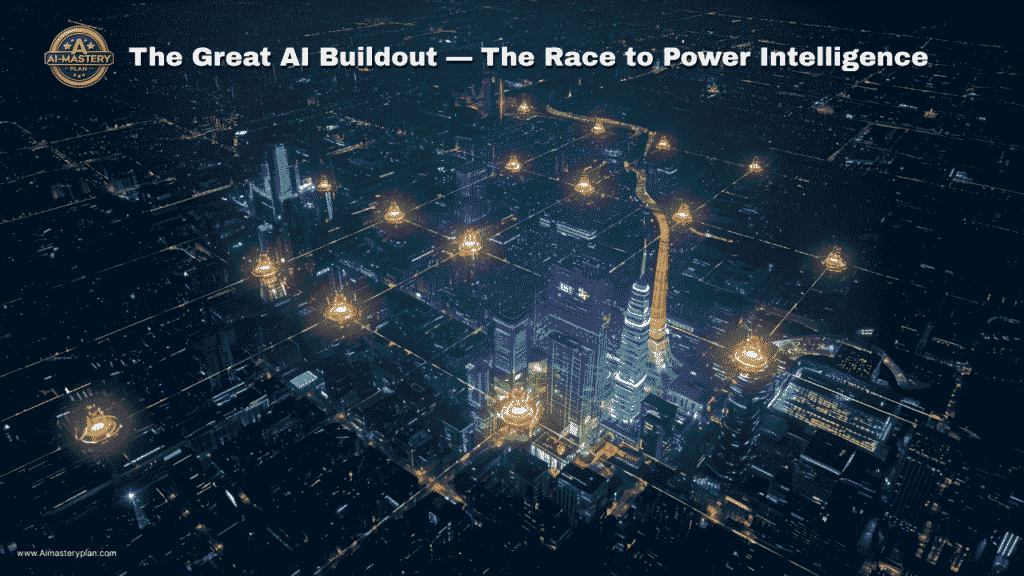
Across the planet, data-center walls are rising faster than office towers.
Behind them hum the machines that will power tomorrow’s intelligence.
From California’s deserts to the outskirts of London and the industrial parks of Singapore, Big Tech is pouring money into the hardware and energy systems that keep artificial intelligence alive.
Analysts call this surge “The Great AI Buildout” — a trillion-dollar infrastructure project that is quietly reshaping economies, jobs, and even global politics.
A New Industrial Age Beneath the Cloud
Artificial intelligence doesn’t live on code alone.
It runs on compute: the electricity, chips, and fiber that allow models like ChatGPT, Gemini, and Claude to think and respond in real time.
Each query sent to an AI model activates thousands of GPUs.
Those processors consume enormous power, releasing heat and requiring constant cooling.
As models grow smarter, their hunger grows too.
That need has pushed tech giants such as Microsoft, Google, Amazon, Meta, and NVIDIA into an unprecedented construction sprint.
They’re building digital factories instead of steel ones, powered not by coal but by electrons.
Bloomberg Intelligence estimates total AI-infrastructure investment could surpass $1.3 trillion by 2030 — roughly the size of the global semiconductor market today.
Britain’s Bold Experiment: A National AI Brain
Nowhere is this transformation more visible than in the United Kingdom.
In partnership with NVIDIA, the government is building a national computing network powered by more than 120 000 Blackwell GPUs.
Officials call it the country’s “AI Brain.”
The system will serve universities, startups, and public institutions, offering computing power once reserved for Silicon Valley giants.
For London, it’s also a declaration of independence.
“Compute power is the new oil,” said a senior U.K. official. “If we don’t build it, we’ll buy it — and that means dependence.”
Economists see the plan as part of a wider trend: nations seeking digital sovereignty — control over their own intelligence infrastructure before the next decade begins.
The Global Buildout
Big Tech’s Expansion
Across the Atlantic, the buildout stretches from Texas plains to Nordic forests.
Microsoft’s Azure campuses are multiplying across North America and Europe.
Google is upgrading its AI clusters in Finland and Japan.
Amazon Web Services has turned Singapore and India into global compute hubs.
Every new complex costs billions of dollars and houses thousands of GPUs.
These facilities no longer produce material goods — they produce knowledge.
Emerging Players
Smaller economies are joining in.
Singapore markets itself as a neutral “data capital.”
The U.A.E. invests in desert-cooled centers powered by solar energy.
India’s Bengaluru and Hyderabad now host a growing ecosystem of AI engineers, chip designers, and cloud providers.
Wherever these hubs rise, new jobs follow: electricians, coders, logistics managers, and security teams.
Energy: The Hidden Currency
Electricity has become the new measure of intelligence.
A single advanced model can use as much energy in a day as 10 000 homes.
To meet that demand, Microsoft and Google have pledged to run their data centers on 100 percent clean energy by 2030.
France is reviving nuclear projects; the U.A.E. is expanding solar megafarms.
Still, analysts warn of a coming energy crunch.
As one expert told AimasteryPlan,
“We’ve built the brains. Now we need to feed them without burning the planet.”
Economic Ripples Everywhere
The AI Buildout 2025 is reshaping global trade.
- Chipmakers such as NVIDIA, AMD, and TSMC run at record capacity.
- Construction firms are booked for years building server halls.
- Renewable energy companies see new demand from tech clients.
In Dublin, taxes from data-center operations fund roads and schools.
In India, state governments compete to attract cloud campuses with cheaper land and faster permits.
The World Economic Forum estimates that AI-related infrastructure could add $500 billion to global GDP by 2030.
For many countries, the AI boom is the new industrial revolution — but cleaner, quieter, and far more connected.
Control and Competition
Beneath the excitement lies a power struggle.
Owning chips and clouds means owning innovation itself.
Startups depend on Big Tech for GPU access, often paying premium rates.
Governments worry that a handful of U.S. companies could control the flow of global intelligence.
Japan, India, and the U.A.E. have launched national AI strategies to build independent compute networks.
Their message is simple: no nation wants to rent its future.
“The next digital divide won’t be about the internet,” said a Tokyo policymaker.
“It will be about who controls compute.”
The Human Buildout
Behind every glowing server hall are people.
Engineers wire the power. Designers optimize airflow. Ethicists audit models for bias.
Experts predict a shortage of 10 million AI-skilled workers within five years.
Countries that train early will dominate later.
India has added AI literacy to national curricula. The EU funds reskilling programs for energy and IT workers. Private academies in the U.S. offer crash courses in data-center management.
“Hardware can be bought,” said researcher Elena Ross. “Human intelligence must be built.”
That belief is turning education into the most strategic resource of the decade.
Environmental and Ethical Pressure
AI infrastructure comes with real-world costs.
Each site draws vast amounts of water for cooling.
Local communities complain about noise and energy use.
Environmental groups want transparency on emissions.
Privacy advocates warn that centralized compute clouds could increase surveillance risks.
In response, the European Union is drafting laws requiring companies to report energy usage and ethical safeguards. Similar rules are expected in Asia and North America.
These pressures may slow the fastest builders — but they could also make the industry cleaner and fairer.
The Bigger Picture
The AI Buildout 2025 is more than a business trend.
It’s the wiring of a new civilization — a global grid for intelligence.
Every server installed today shapes how knowledge, jobs, and creativity will move tomorrow.
Every GPU is a small piece of power in the digital order forming before our eyes.
The industrial age was built on steel and oil.
The digital age ran on data.
The age ahead will run on compute.
“The superpower of the future won’t be the richest country,” said a veteran engineer.
“It’ll be the one with the most compute.”
And somewhere, beneath fields and cities, that future is already humming.